 FLM
FLMA language model you can look inside.
What changes when a language model learns through the wiring of a fruit-fly brain?
FLM is trained from scratch on a connectome-derived recurrent network. No pretrained transformer supplies its answers or animates its neural states. Learned text embeddings and readout layers connect language to a modeled subset of fly wiring. This is a small foundational architecture experiment, not an intact biological brain or a claim of general-purpose intelligence.
Watch real recurrent states change with each token. Silence a neuron, remove communication, replay the same input, or adapt the readout and measure a separate probe. Initial-versus-trained core studies and recorded physical replays let us distinguish changes in computation from changes in a body's behavior. The typing fly is an articulated illustration; measured physical behavior lives in the separate studies below.
The contribution is the combination of declared anatomical wiring, learned recurrent dynamics, controlled language comparisons and inspectable inference. Completed WikiText-2 and BabyLM studies let us separate the value of memory and learned dynamics from the value of this particular graph. The model selector includes every completed primary checkpoint and its conventional baselines.
How chat, system context and automatic model selection work
The architecture
Current architecture specification · Dataset and model status · Research foundations
The connectome determines which directed recurrent edges exist and their assumed fast neurotransmitter signs. Training adjusts their magnitudes, an input projection, bounded time constants and a readout. A slow state filters each neuron’s activity, giving the model two memory timescales. This is a differentiable rate network, not a biophysical reconstruction.
| Property | FLM compact | Decoder transformer |
|---|---|---|
| Communication | Fixed directed graph; trained edge strengths | Content-dependent attention between token representations |
| Memory | Fixed-size fast and slow recurrent state | Past token keys and values, within a context window |
| Position in sequence | State evolves in causal order | Position encoding and causal attention |
| Learning | Next-token cross-entropy and backpropagation through time | Next-token cross-entropy and backpropagation |
| Browser adaptation | Separate online readout adapter | Architecture-dependent; not a defining transformer feature |
| Tradeoff | Small state; sequential training and lossy memory | Parallel training; more expensive long-context attention/cache |
How the experiment grew
The first FLM learned from human meeting transcripts. WikiText-2 made the comparison reproducible: the same tokenizer, sampled text and training budget for a fly-derived recurrent core, a GRU and a decoder transformer. Rewired graphs and retrained mechanism controls then separated two questions: what recurrent computation contributes, and whether the measured wiring itself helps.
BabyLM extended the experiment to a standard mixture of conversation, child-directed speech, books, subtitles and encyclopedia text at 10M and 100M word budgets. All twelve fits and their held-out evaluations are complete. ChatFLM now runs those checkpoints alongside the six WikiText models and the earlier AMI model, with a validation-selected FLM default.
The next study changes which neurons are retained. Its 128 registered fits compare two Kenyon-cell-centered selections with connectivity-ranked, random and rewired counterparts. This asks whether a functional circuit is a more useful starting point than a connectivity ranking. Training is underway; its conclusions remain open.
Which property of the biology survives?
The retained arrangement of connections is the anatomical hypothesis: does it supply useful recurrent structure beyond the degrees, signs and allocation preserved by the rewired controls? The rate equations, lexical interface and fast/slow memory are engineered choices. Useful temporal computation and useful anatomical arrangement are separate claims.
The running KC-centered study is now a bounded decision point. A dated interpretation and stopping rule, adopted after training began and before its held-out results, requires a minimum gain and consistency across the declared groups, seeds and rewires before one confirmation study. A valid completed failure ends further anatomical subset searches in this program. Broader scaling and other prepared experiments are deferred.
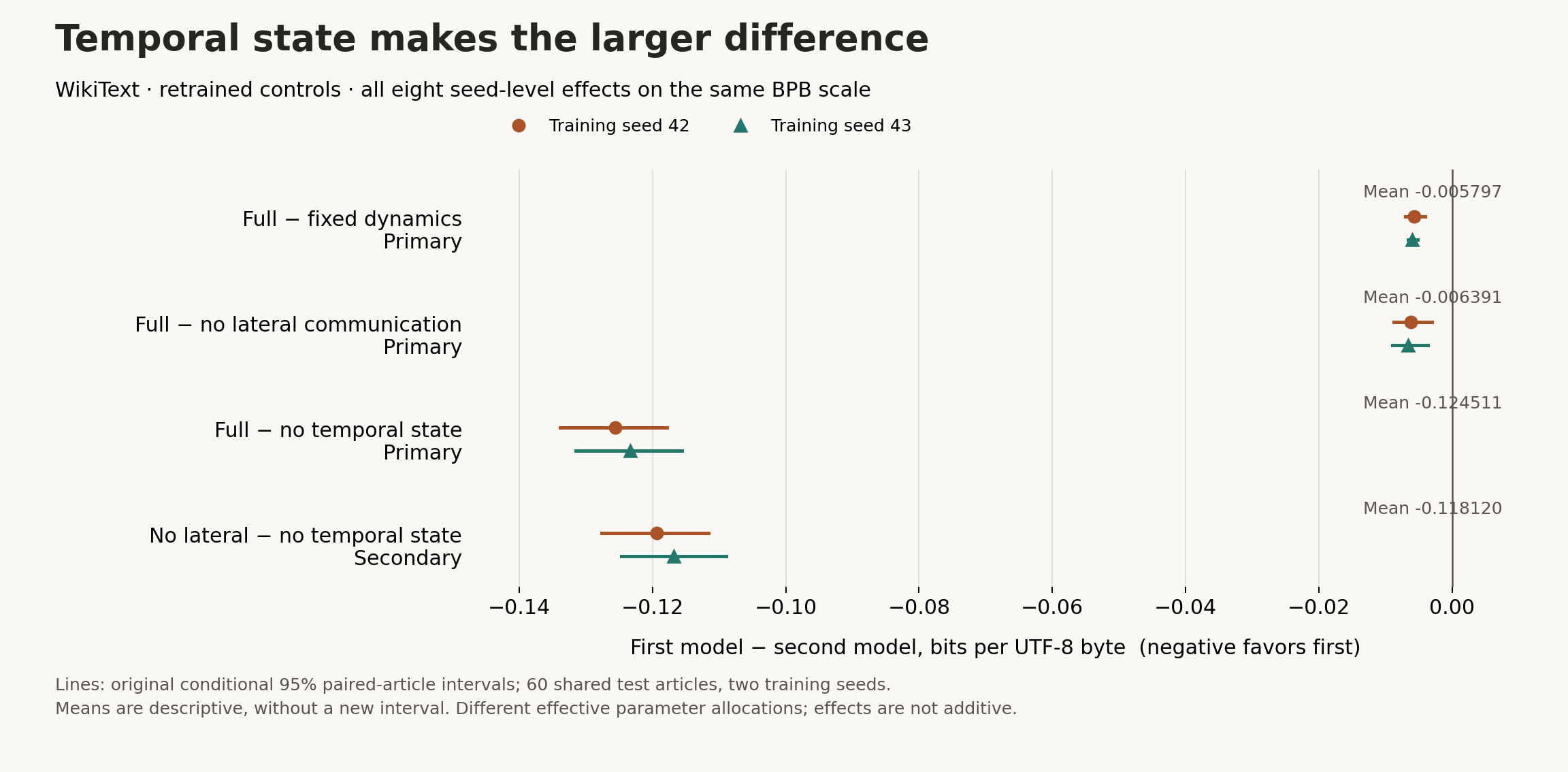
Our immediate focus is where prediction capability resides: a synthesis of the completed temporal-state, lateral-communication and dynamics controls, using existing records. The complete 128-fit study now runs freshly on an Apple M5 Pro CPU under a disclosed execution amendment. Different native initialization hashes keep the stopped Windows attempt separate; the scientific design and decision thresholds are unchanged. All 128 training fits and checkpoint selections are complete; held-out evaluation is running, and the anatomical comparison remains pending. The repository is public as of 12 September 2026. Four trained KC research previews are available while full evaluation continues. The decision reporting guide explains the eventual comparison. Release status.
What learning changes in the network
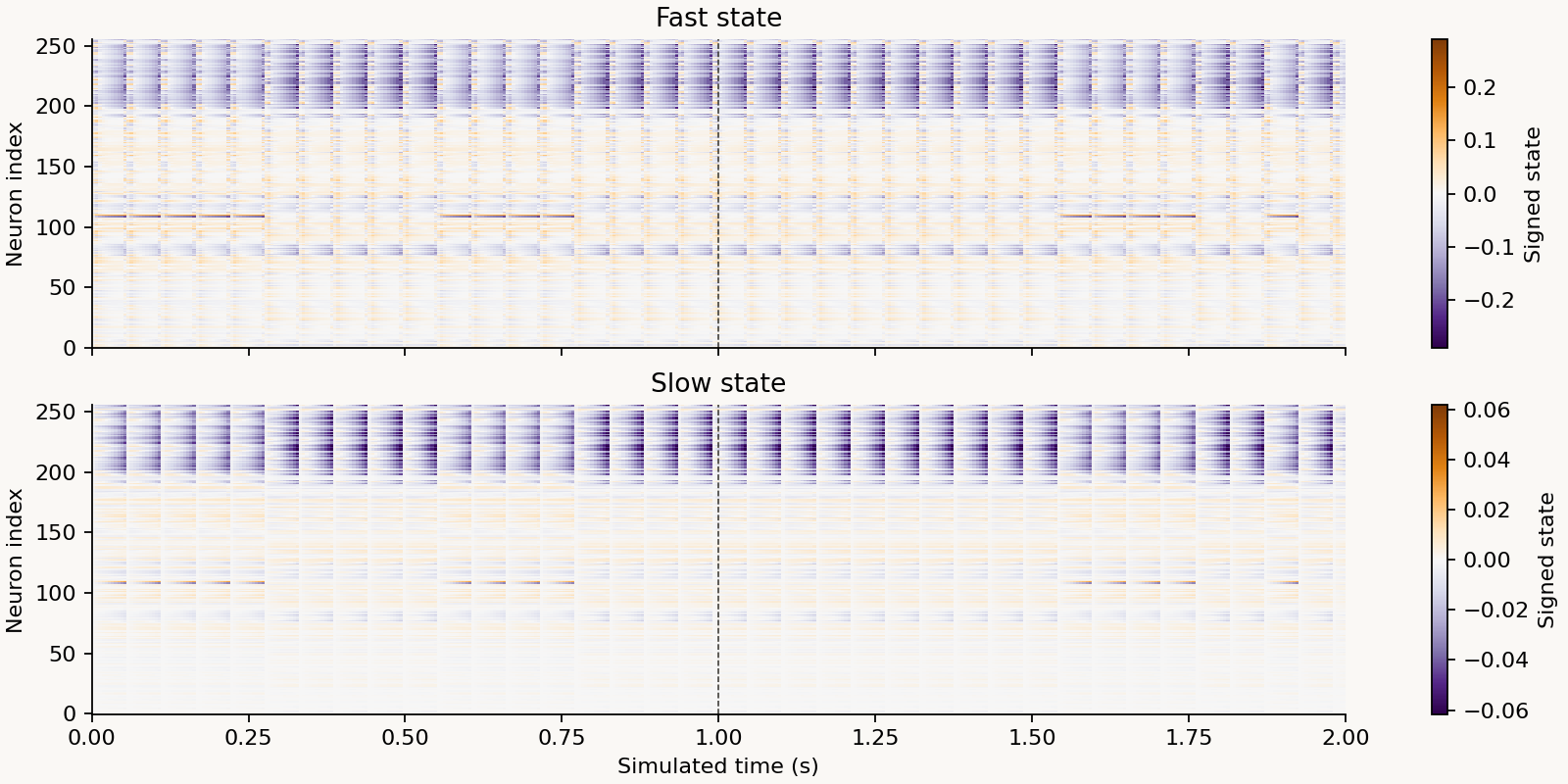
Replaying the same paragraph before and after training gives different fast and slow state responses. Removing recurrent communication raises validation loss from 1.910 to 2.063 bits/byte; removing the slow state raises it to 1.995. Both mechanisms contribute to this trained model. These acute interventions do not establish that fly anatomy outperforms a different graph.
Loading the completed, retrained computation comparison. Read its frozen protocol.
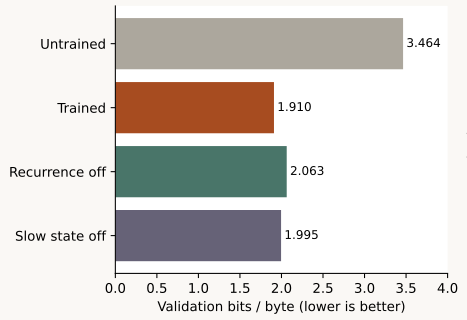
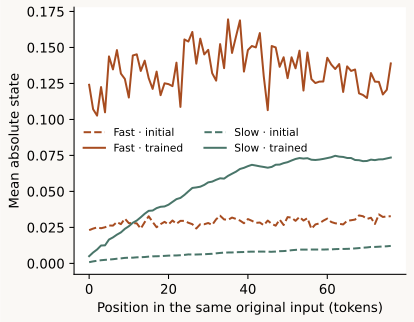
Scores, stimulus and checkpoint identity · State response data · CSV
Controlled pulse responses before and after language training
Seven recurrent-core conditions receive the same synthetic pulse, bypassing the lexical interface. The zero-state fast spectral radius changes from 1.0207 at initialization to 0.9912 and 0.8722 for the two trained seeds. Swapping in learned edges and gain closely reproduces that shift; swapping only time constants does not. This is a diagnostic of model dynamics, not a language-quality, useful-memory or behavioral-transfer result.
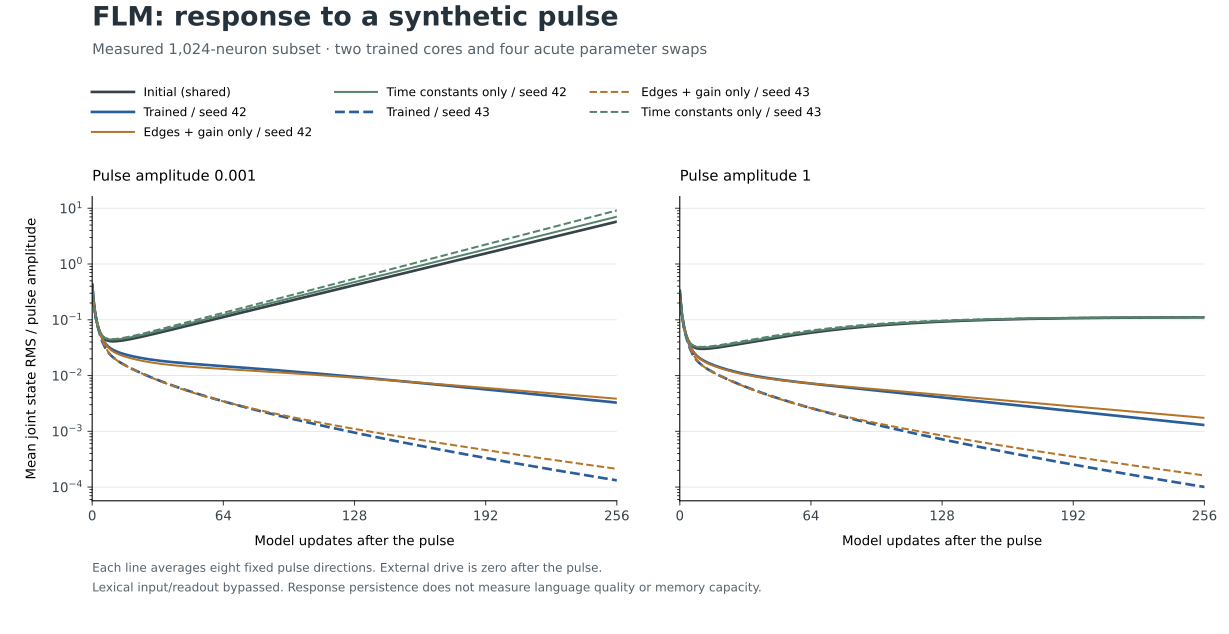
All seven cases reproduce every metric and saved array exactly in the recorded CPU environment. The standalone archive includes recurrent parameters and numerical sources; it needs no corpus or original full checkpoints.
What changes in the fly?
Language training changes how the recurrent core responds to the same input: its learned edge strengths, rates and lexical interface produce different fast and slow trajectories. Separate sensory training teaches delayed decisions and rule reversal. Those decisions can steer an articulated physical fly through a designed motor interface, giving us experiments in memory, adaptation and feedback.
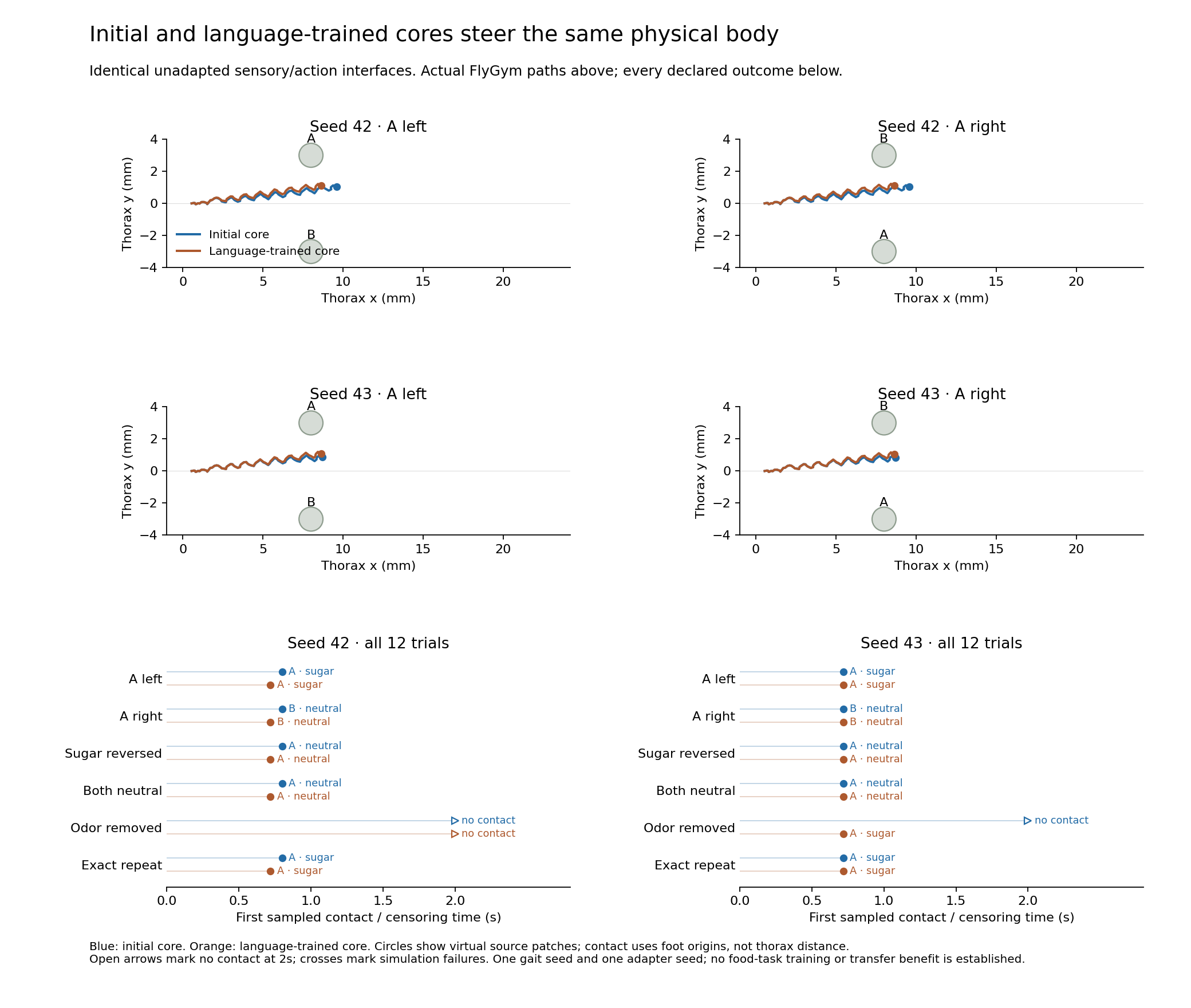
Before/after food references put initial and language-trained cores in the same engineered sensory interface. Their recorded paths and neural states make changes observable, including wrong-source contacts and timeouts. They have received zero food-task updates; beneficial transfer and learned feeding remain questions for subsequent experiments.
Separate sensory and physical studies
Learning with forward eligibility traces
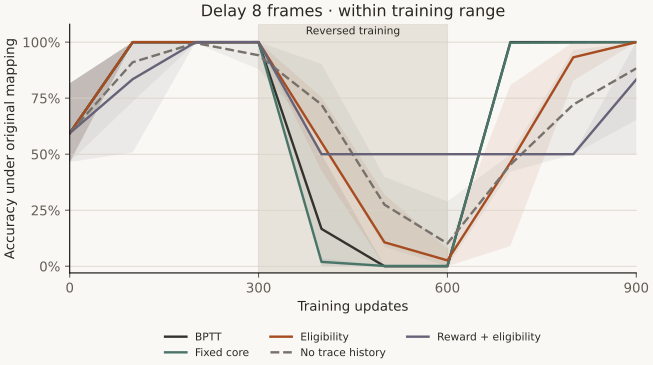
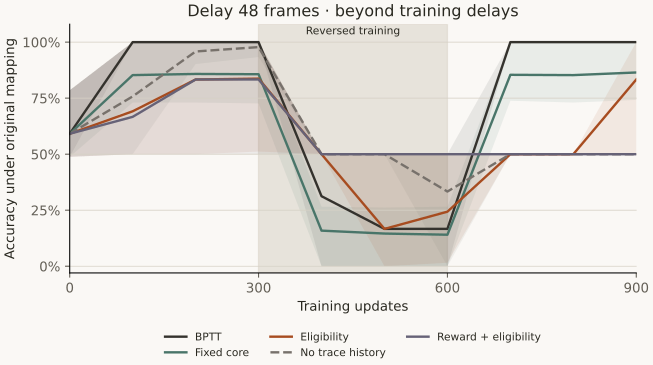
A separate 256-neuron FLM choice model compares five learning rules on the same cue-and-delay task. It sees a brief cue, waits through a distractor, then chooses a direction. The cue-to-direction rule reverses after 300 updates and returns after 600. Every condition starts from the same weights within each of three seeds and receives 7,200 training episodes.
Eligibility traces carry each parameter's local contribution forward until an error or reward arrives. This implementation updates recurrent edge strengths, input responses and time constants without backpropagating through earlier states. It omits indirect temporal credit through other neurons and still uses an engineered output layer. It is a rate-network experiment inspired by e-prop, not a claim of fully biological learning.
| Learning rule | Delay 8 | Delay 12 | Delay 48 |
|---|
The fixed-core control learns only 258 output and normalization parameters; the other conditions can update all 8,729 parameters. Its strong result shows that solving this task alone does not demonstrate a benefit from changing recurrent wiring. The 48-frame probe extrapolates beyond the 4–12-frame training delays. These repeated diagnostic panels are separate from language-model test data.
What this learning comparison does and does not show
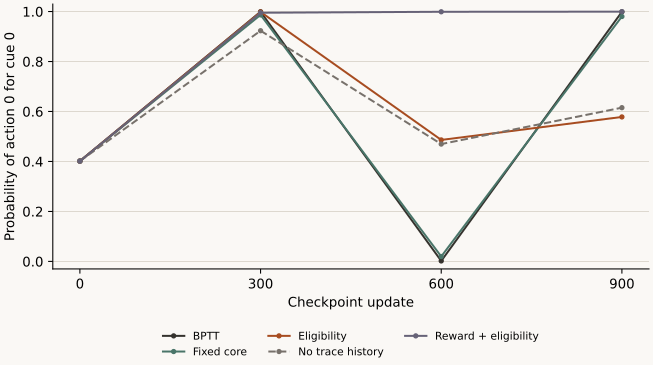
The supervised eligibility rule outperforms its no-history control on the final long-delay probe, but falls short of full backpropagation. Reward-gated learning can acquire the first association and then fail to adapt after reversal. Three seeds and one simple task do not establish a general ranking. The wiring comparison below tests that contribution on two artificial tasks.
For a batch of eight, the implementation stores 558,464 bytes of eligibility tensors, in addition to 16,384 bytes of recurrent state. Trace storage is fixed with episode length, but grows with the number of parameters. This is not a measured peak-memory or energy advantage over backpropagation.
Wiring controls on cue and context tasks
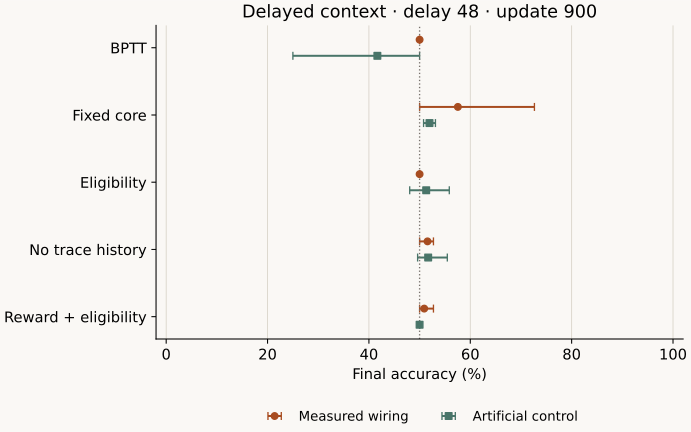
A sixty-run extension compares measured wiring with three artificial graphs. Each control preserves every neuron's incoming and outgoing connection counts, input signs, incoming weight magnitudes and self-connections. The new edges are randomized connections between the same nodes. They are not measured synapses.
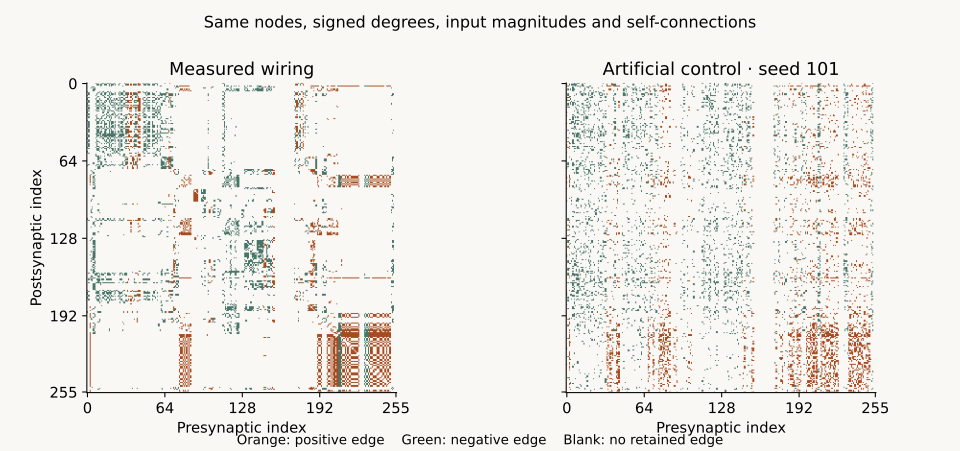
The original cue task is repeated, and a delayed-context task requires two remembered values: a cue, then a later context cue. The network chooses action 0 when they match and action 1 when they differ. Training reverses and restores that rule. The fifteen repeated measured-graph cue conditions reproduce the earlier model tensors exactly; they are not extra independent seeds.
Loading the complete wiring comparison…
| Learning rule | Measured wiring | Artificial control | Paired difference · mean (seed range) |
|---|
Inspect each paired seed
| Learning rule and seed | Measured wiring | Artificial control | Difference |
|---|
How accurate is the local learning signal?
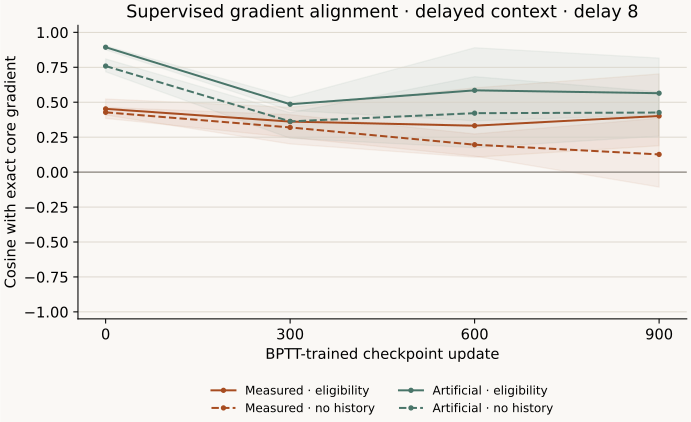
At the same checkpoint and stimulus, the local approximation can be compared with the exact supervised gradient. A cosine of 1 means matching directions; 0 means perpendicular directions; negative values point against the exact gradient. The plotted checkpoints were trained with BPTT. This derivative diagnostic uses supervised loss even when inspecting a reward-trained network, and never changes the trained model.
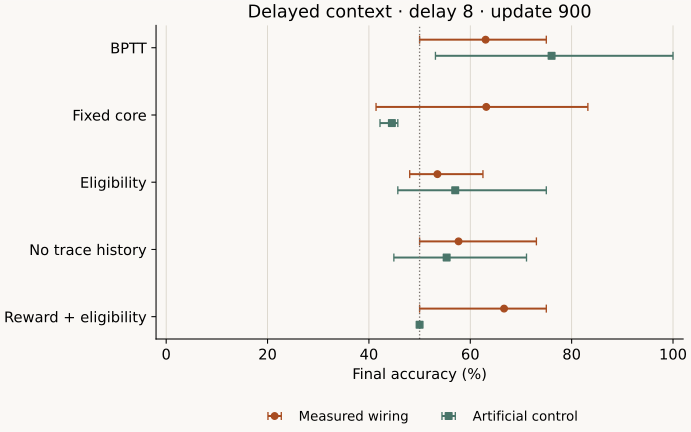
The outcome depends on the task and learning rule. At the final delay-8 context probe, BPTT averages 63.02% with measured wiring and 76.04% with the rewired controls. At delay 48 in the simpler cue task, the corresponding means are 100% and 66.67%. These are repeated diagnostic panels from artificial tasks. Three paired model/null seeds cannot separate uncertainty from initialization and random topology. The context task also contains more frames per episode. Results here do not establish a language-model advantage, a biological explanation or a learned gait.
A learned choice changes the physical fly’s direction
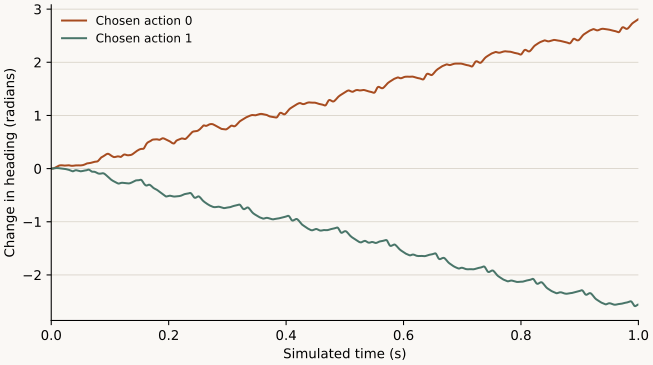
The choice model now supplies a high-level command to the calibrated fly simulator. For each learning rule, both cues were replayed at four fixed checkpoints from seed 17. All 40 cases were simulated separately for one second. Their recorded heading follows the chosen command in every case, including cases where the network chose the wrong direction for the task.
| Learning rule | Initial | Update 300 | Update 600 | Update 900 |
|---|
Compare the fly before and after cue training
Scrub through the same simulated time for the untrained and trained sensory-choice networks. These are recorded thorax positions and headings from the existing 40 trials. The fly icons are schematic; both plots use the same coordinates and scale.
Loading the verified physical recordings…
Before training · 0 updates
After training
Orange shows the path up to the selected frame; gray shows the complete recording. The first saved frame is at 0.0001 s. Every tenth recorded frame is shown without interpolation. All 40 trials reduce to two motor commands and two exactly repeated paths, not 40 independent motor skills.
This model learned abstract cues, not text or food sensing. Food sensors and a scripted odor-approach reference are separate engineering tests; the before/after study outline distinguishes them from the proposed food-learning comparison.
The neural choice is computed before the physics replay. This first assay has no online proprioception, learned balance or language-to-motor transfer. It uses the smaller sensory-choice network and a female NeuroMechFly body. The browser’s language-driven pose remains a separate illustration.
Steering with current body feedback
The physical fly's position and heading now determine the next sensory cue. The 256-neuron choice network reads that cue, waits through eight blank frames and selects a turn. A designed FlyGym gait controller executes the command. These are fixed sensory-choice checkpoints, separate from the language models; no weights change during the physical trials.
Loading the complete physical feedback comparison…
| Controller | Live pose | Frozen pose | Live − frozen |
|---|
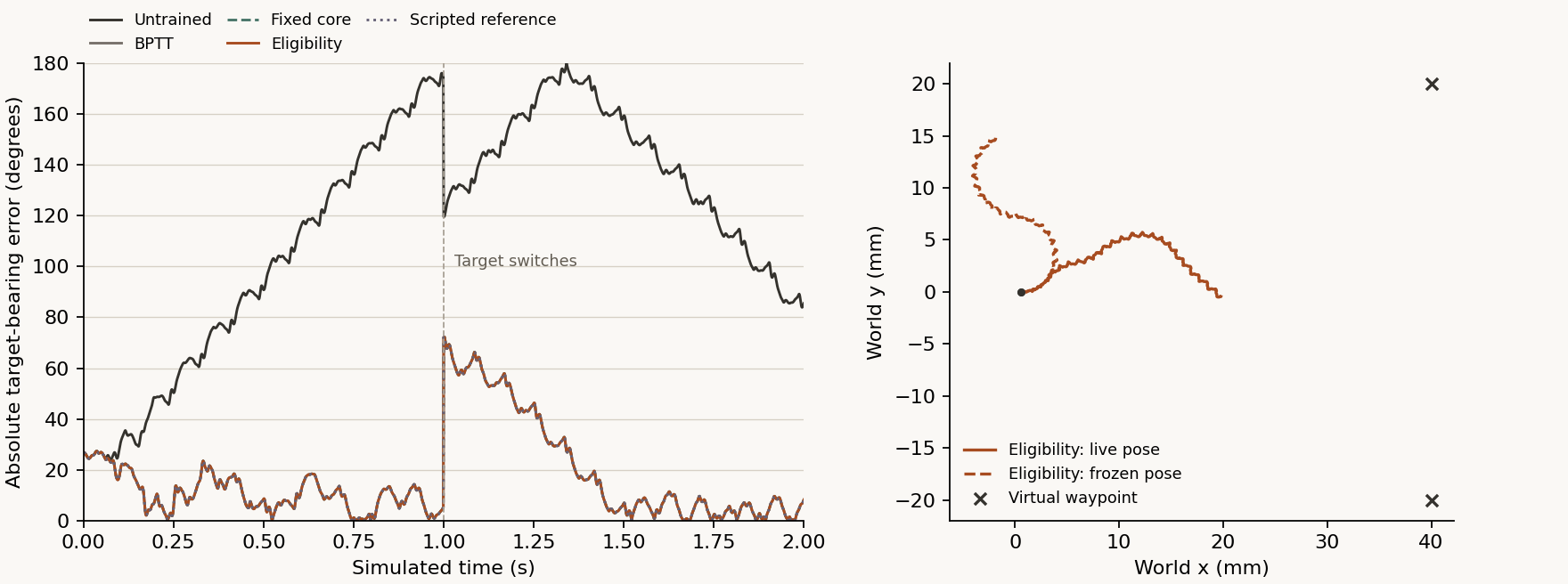
Final outcomes and progress within each target phase
| Condition | Final angular error | Final target distance | Phase progress | Command changes |
|---|
The scripted reference computes the turn directly from the same sampled cue. It shares the 50 ms delay, straight-ahead deadband and gait interface. Matching this reference establishes that the learned cue mapping works through this interface; it does not establish a benefit from trained recurrent dynamics or anatomical wiring. The single training seed and single physical seed do not support population confidence intervals.
Recorded neural state in the video trial
Following odor with a scripted controller
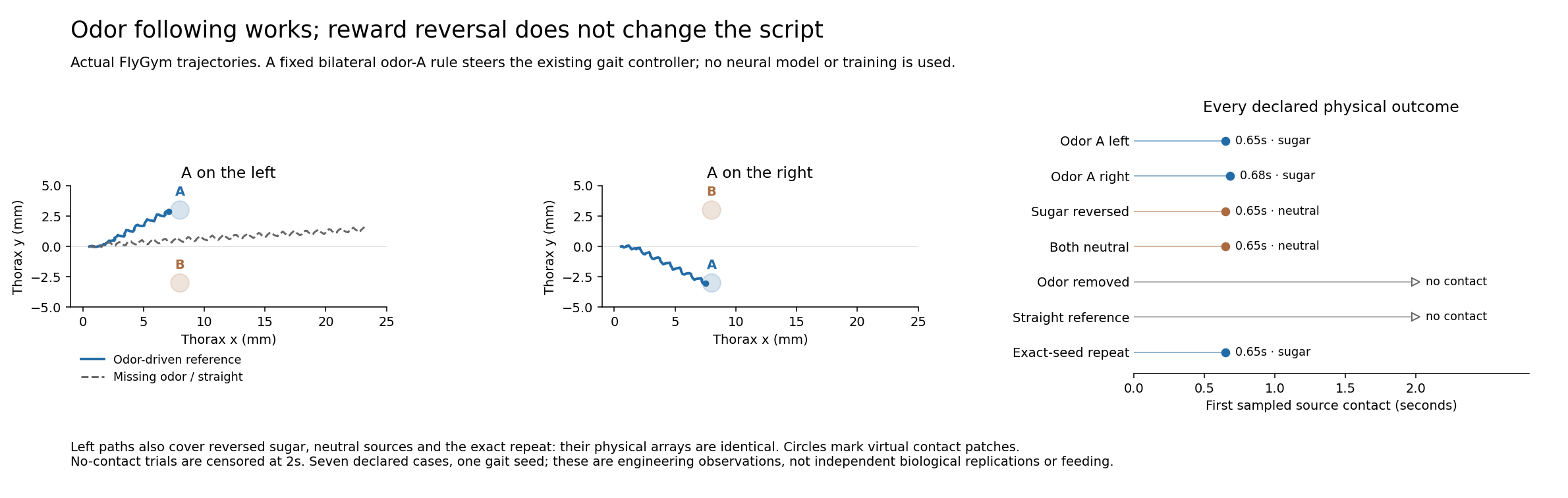
A fixed rule now steers the physical fly using the difference between odor A at its left and right antenna origins. It receives no source coordinates and stops when a foot-origin contact sensor fires. All seven declared cases completed; no neural model or training is used.
| Condition | Contact time | Outcome |
|---|---|---|
| Odor A on the left | 0.65 s | A · sugar |
| Odor A on the right | 0.68 s | A · sugar |
| Sugar identities reversed | 0.65 s | A · neutral; sugar remains at B |
| Both sources neutral | 0.65 s | A · neutral |
| Odor removed | No contact by 2 s | Censored at the full time budget |
| Straight reference | No contact by 2 s | Censored at the full time budget |
| Exact-seed repeat | 0.65 s | A · sugar |
The rule follows an odor even after the sugar assignment changes. It has no learned association to reverse. This supplies a physical reference for later learning tests; it establishes neither language transfer nor a feeding response. A standalone audit replays all 1,407 recorded sensor and command observations without rerunning physics.
Language-trained cores before food-task adaptation
All 24 declared physical trials completed: two initialization seeds, each before and after WikiText training, across six conditions with identical fresh sensory/action adapters. Both core types contacted the upper patch in the mirrored cases, including the neutral patch when odor A was on the right. These contacts do not establish an odor association or a benefit from language training.
Replay recorded motion and neural state · all 24 conditions
Open to load the 3D replay. Each selected recording downloads about 2.4 MB.
Recorded body motion
Actual 1,024-neuron model state
Switch the core at the same time sample to compare before and after language training. The physical body and male brain graph come from different specimens. Joint geometry is reconstructed from saved qpos; sensor and contact values use the original cached positions. The body-state note explains the integration-stage difference and invalid saved head row. This viewer uses the valid head mesh transform.
A physical body, with reproducible controls
A separate NeuroMechFly / FlyGym experiment establishes walking and turning in MuJoCo physics. Symmetric drive moves the thorax 13.46 mm along the x axis in one simulated second. Opposite drive asymmetries produce opposite turns. Repeating the symmetric trial with the same initial state reproduces the recorded trajectory exactly.
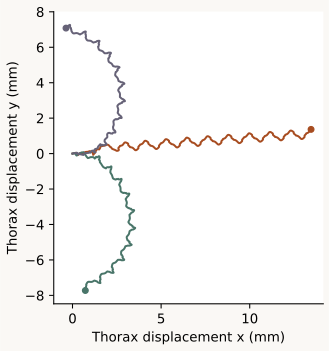
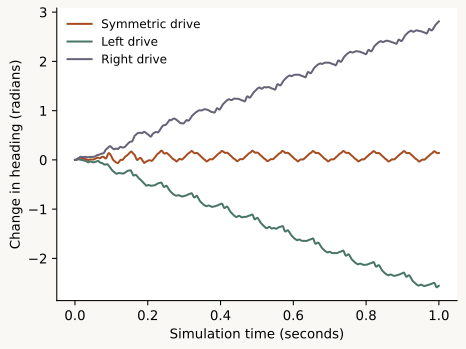
Controller settings and measured outcomes · Trajectories · CSV
Detailed comparisons and statistical evidence
The following records put the mechanism and behavior observations in context: every declared wiring contrast, architecture baseline, training seed and held-out result remains available. Mechanism effects and anatomical advantage are separate claims.
Does measured wiring help language?
Measured wiring shows no advantage in this language experiment. All six rewired fits have slightly lower test loss than their paired measured references. Three of the six conditional article intervals include zero. Separately, the model with slow state outperforms both models retrained without it. These findings concern this selected subset, architecture, corpus and training budget.
The three independently rewired graphs preserve every neuron's directed in/out degrees, source sign, incoming signed weights, original self-connections and pool membership. Each was trained with both original initialization seeds, using the same 1,024 nodes, initial parameter tensors, tokenizer, sampled text, optimizer and 6,000-update budget as the measured references. All controls started from scratch.
Why 1,024 neurons? The selector ranks 32,164 central-brain intrinsic neurons by their incoming-plus-outgoing contacts within that population, then applies a computational size limit. This cuts 79.42% of the selected neurons' incoming and 73.96% of their outgoing raw contacts. The retained graph is not an intact biological circuit. The selection and boundary audit records the exact rule, cell-type coverage and per-neuron losses.
Loading the language control snapshot…
Completed language topology test
All eight new runs finished before their test checkpoints were frozen. Scores cover all 60 WikiText-2 test articles. The original measured test results had already been inspected; this is an exploratory extension.
All ten checkpoint scores, paired contrasts and graph means
| Condition | Training seed | Selected update | Test bits / byte | Token perplexity |
|---|
| Comparison | Training seed | Difference · BPB | Article interval |
|---|
| Graph seed | Mean measured minus rewired · BPB |
|---|
The six topology contrasts share two measured references; they are not six independent replications. Article intervals do not include graph, initialization or dataset uncertainty. Every condition allocates 600,003 parameter entries, but the no-slow model's 1,024 beta entries are disconnected from its loss. This study does not estimate an interaction between topology and slow memory.
All selected checkpoints, test articles and paired comparisons
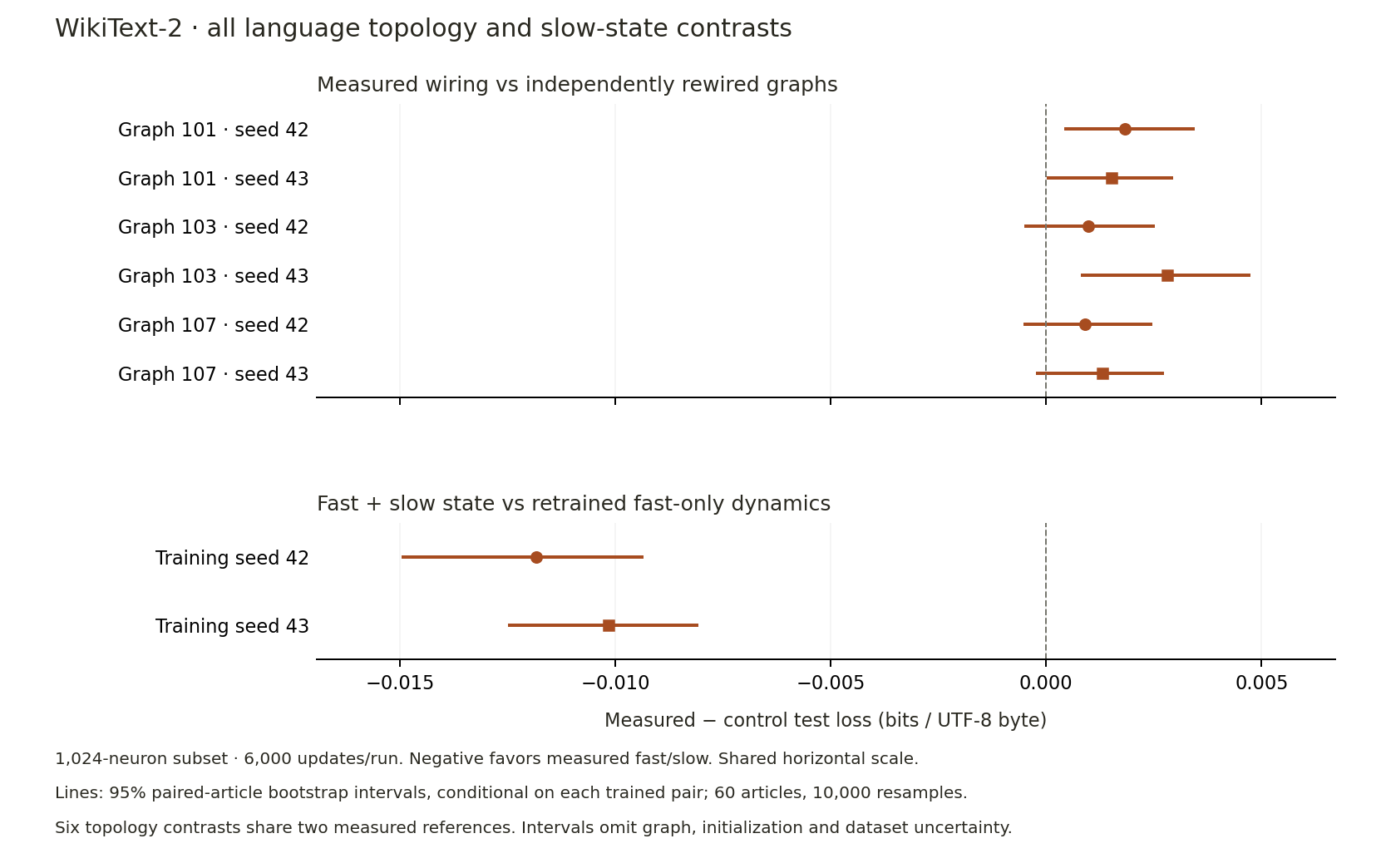
The NumPy-only checker recomputes reported losses, means and intervals. This checks the supplied arithmetic; it does not rerun training or test inference.
Run the measured, rewired and retrained no-slow models locally with the same prompt. The download includes all ten selected checkpoints, their exact graphs, the shared tokenizer and installation instructions. These are text-continuation models without instruction tuning.
Matched validation scores at 6,000 updates
| Control | Training seed | Shared update | Measured BPB | Control BPB | Difference |
|---|
All eight new runs finished before all ten test checkpoints were frozen. Three graph seeds crossed with two training seeds expose both sources of variation; the six contrasts share two measured references. Slow-state retraining is separate from disabling memory only during inference. The cue/context experiments below answer a different question.
Inspect the measured graph and all three wiring controls
Loading the frozen graph audit…
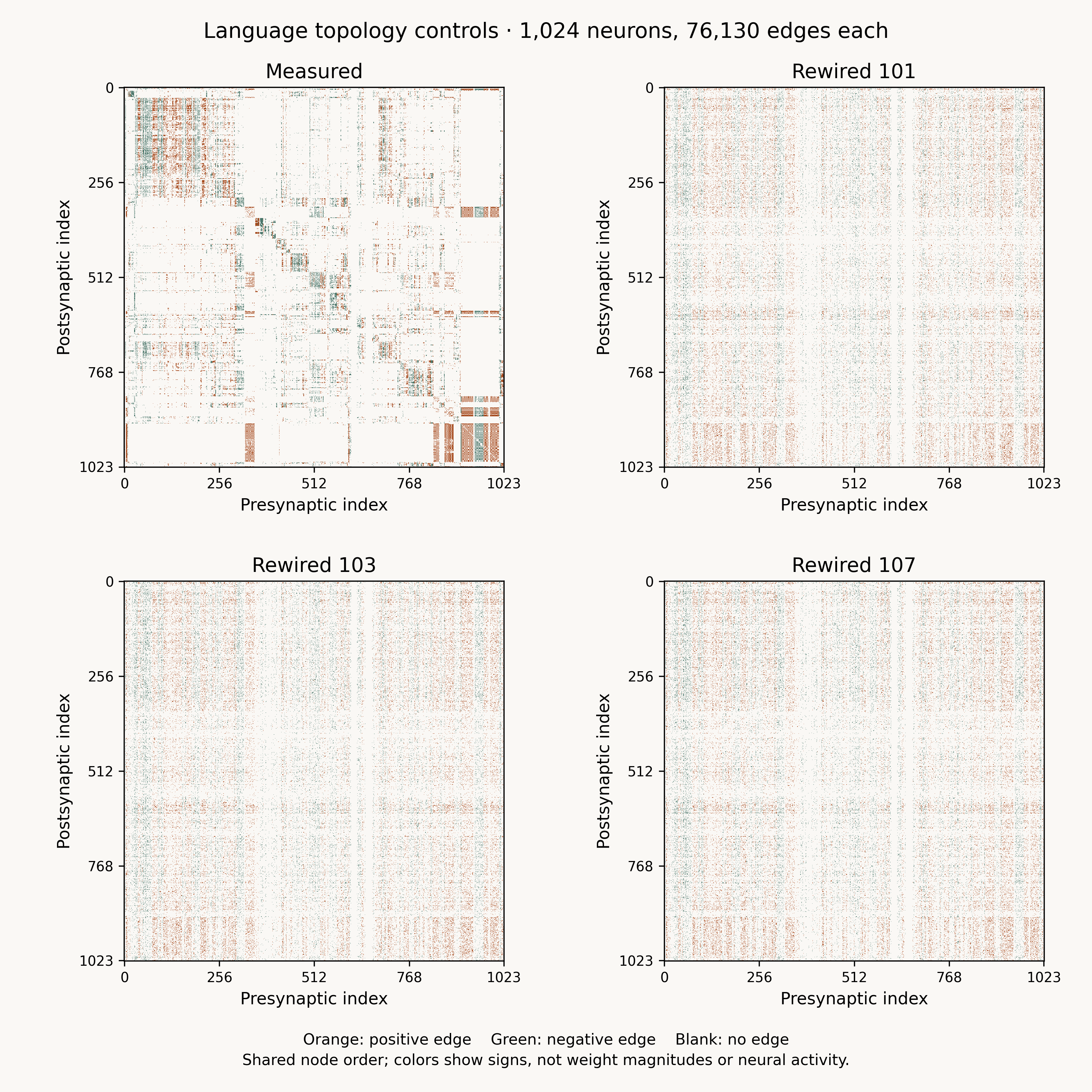
| Graph | Measured edges retained | Reciprocal edges | Strong components | Largest component | Accepted swaps |
|---|
Reciprocity is the fraction of non-self directed edges whose reverse edge exists. A strong component is a set of nodes that can all reach one another through directed paths. These quantities and outgoing weighted strength are allowed to change; equal component counts here are an observed result. The controls retain anatomical identities, degrees, signs and pooling, so this tests higher wiring organization conditional on those features.
Each null uses a separately seeded chain with ten accepted swaps per edge. This finite budget does not establish uniform sampling or adequate mixing. Structural differences alone do not tell us whether a graph helps language prediction.
Next graph study: functional selection, connectivity ranking and random subsets
Which neurons should be retained?
The current negative topology result concerns one heavily truncated subset. Eight operational KC-centered candidates now have seven comparison selections each: connectivity-ranked, uniform random and superclass/side/sign-stratified random subsets at each candidate's neuron count. All 64 original graphs and their 192 rewired controls are exported and independently audited. No selection language fits have run; the training matrix remains unfrozen.
An anatomy-only audit found 4,497 neurons in the named mushroom-body families; either unilateral inventory also exceeds 1,024. Three uniform 1,024-node draws retain only 6,248–6,475 fast edges, compared with 76,130 in the current model. Matching neuron count alone would leave substantial differences in density and trainable parameters.
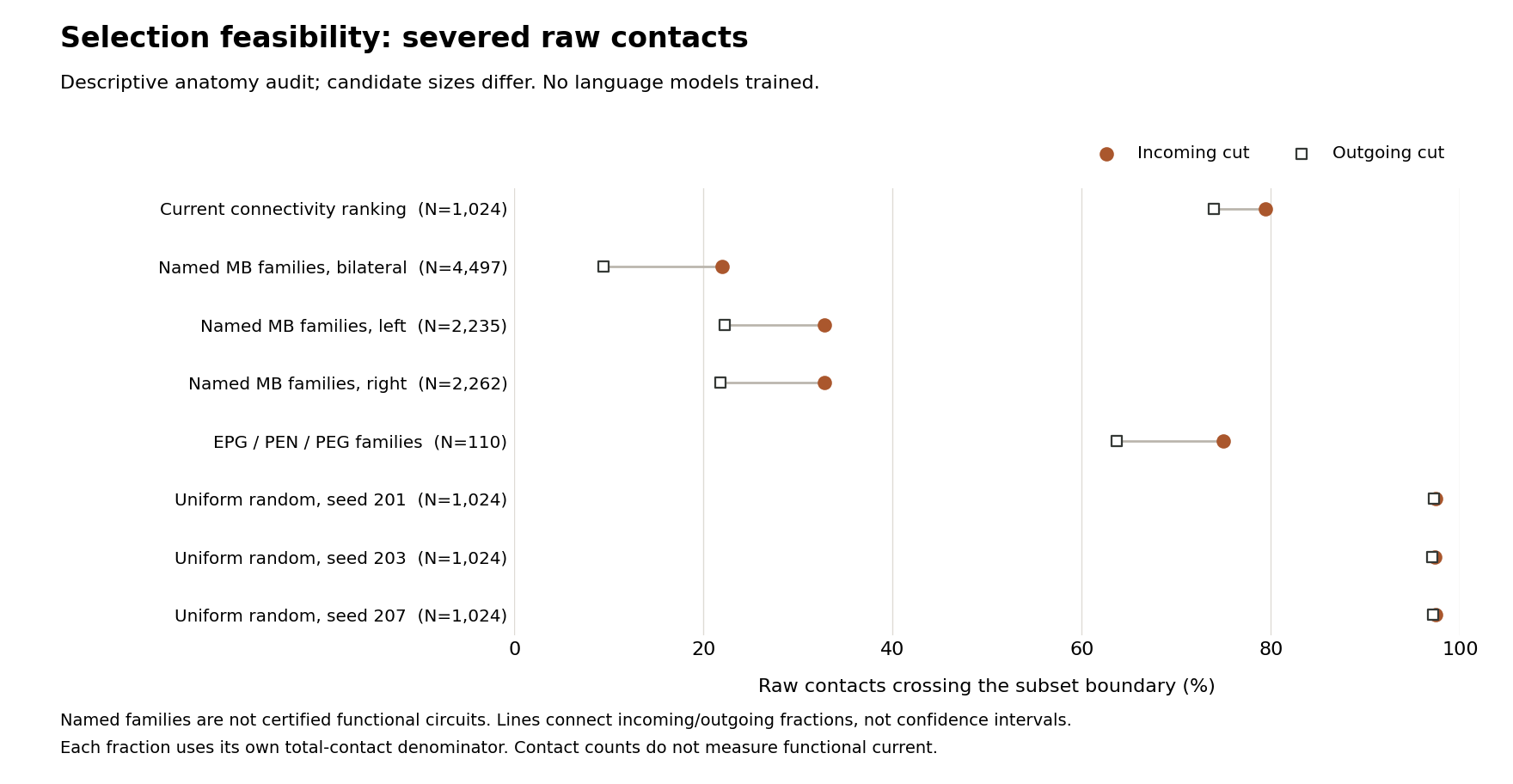
Selection is also separate from dynamics: all 316 PAM and 16 PPL1 cells have fast sign zero in the acquired runtime, so their outgoing connections would be omitted even if selected. A biological plasticity extension needs its own stated mechanism and controls.
Selection plan, evidence and limitationsEvery candidate and contact countExact candidate body IDsPlotted measurements · CSV
Prepared circuits and their structural controls
The new candidates retain all eligible seed cells of one KC subtype on one side, then add partners by declared contact rules. At membership threshold 5, the KCg-d candidates retain about 81–85% of seed-KC incoming/outgoing raw contacts, while still cutting about 89% of whole-subset incoming contacts. The KCg-m candidates retain over 96% of seed-KC contacts. These are operational selection hypotheses, not certified functional circuits.
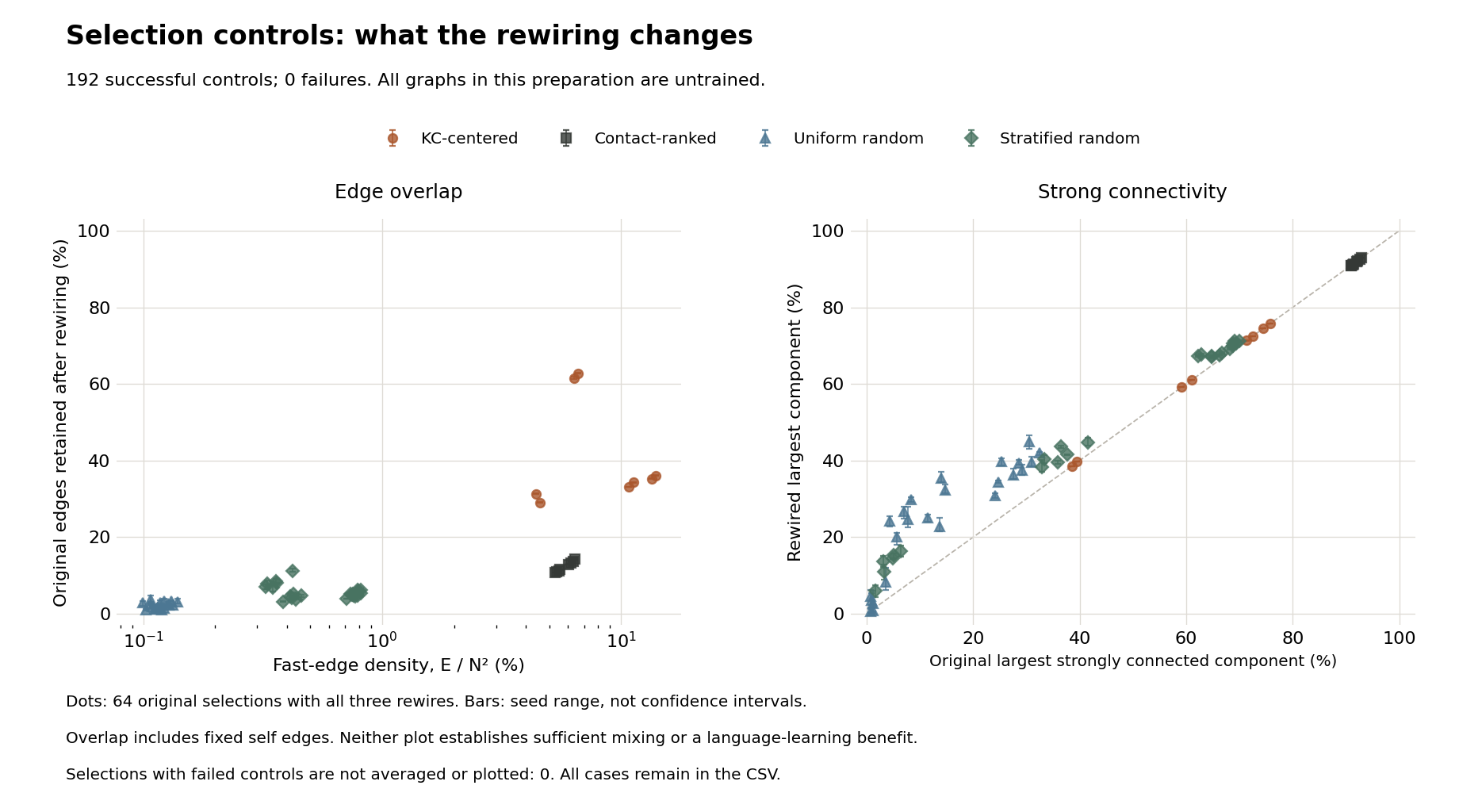
Exact selection rules and boundariesCompleted structural audit64 originals + 192 rewires · ZIP, 25.4 MiBEvery control · CSV
Held-out language comparison
Loading verified scores from the six completed runs…
| Model | Seed 42 | Seed 43 | Mean | Seed SD |
|---|
Paired uncertainty and the n-gram reference
| Comparison | Training seed | Difference | 95% article interval |
|---|
Intervals resample the same test articles together 10,000 times. They describe uncertainty conditional on these trained checkpoints.
A standard corpus, trained from scratch
The controlled WikiText experiment uses WikiText-2 raw: 600 training articles, 60 validation articles and 60 test articles, preserving the official partitions. The training set contains 2,051,910 whitespace-delimited words and 10,914,845 UTF-8 bytes. This is written Wikipedia-derived text, not speech transcripts.
A lossless 4,096-token byte-pair vocabulary is learned exclusively from the training articles. FLM, a GRU and a small decoder transformer share this tokenizer, training windows and approximately 600,000 trainable parameters. There are no pretrained weights or teacher-generated training examples. Results are reported in bits per UTF-8 byte; perplexity is comparable only within this shared tokenizer.
The earlier AMI Meeting Corpus experiment uses manual transcripts under CC BY 4.0: 139 training, 16 validation and 16 test documents in custom participant-disjoint partitions. It remains a separate dialogue study. WikiText source metadata and its differing license statements are documented in the dataset card; corpus text is not redistributed here.
BabyLM: completed 10M and 100M comparison
BabyLM: 10M and 100M words
This completed study uses the BabyLM 2026 corpora: 10 million and 100 million training words, downloaded at fixed revisions and verified locally. The mix covers spoken conversation, child-directed speech, books, subtitles and encyclopedia text. This is a compact comparison within FLM, not an official Challenge leaderboard submission.
| Component | 10M corpus | 100M corpus | Language domain |
|---|
A shared vocabulary is fitted only on the 10M training partition. All twelve FLM, GRU and transformer fits completed 12,000 updates and 18.43 million input-token presentations. This compares data diversity at fixed sampled exposure; it does not mean one complete pass through the 100M-word set or equal runtime.
Held-out results
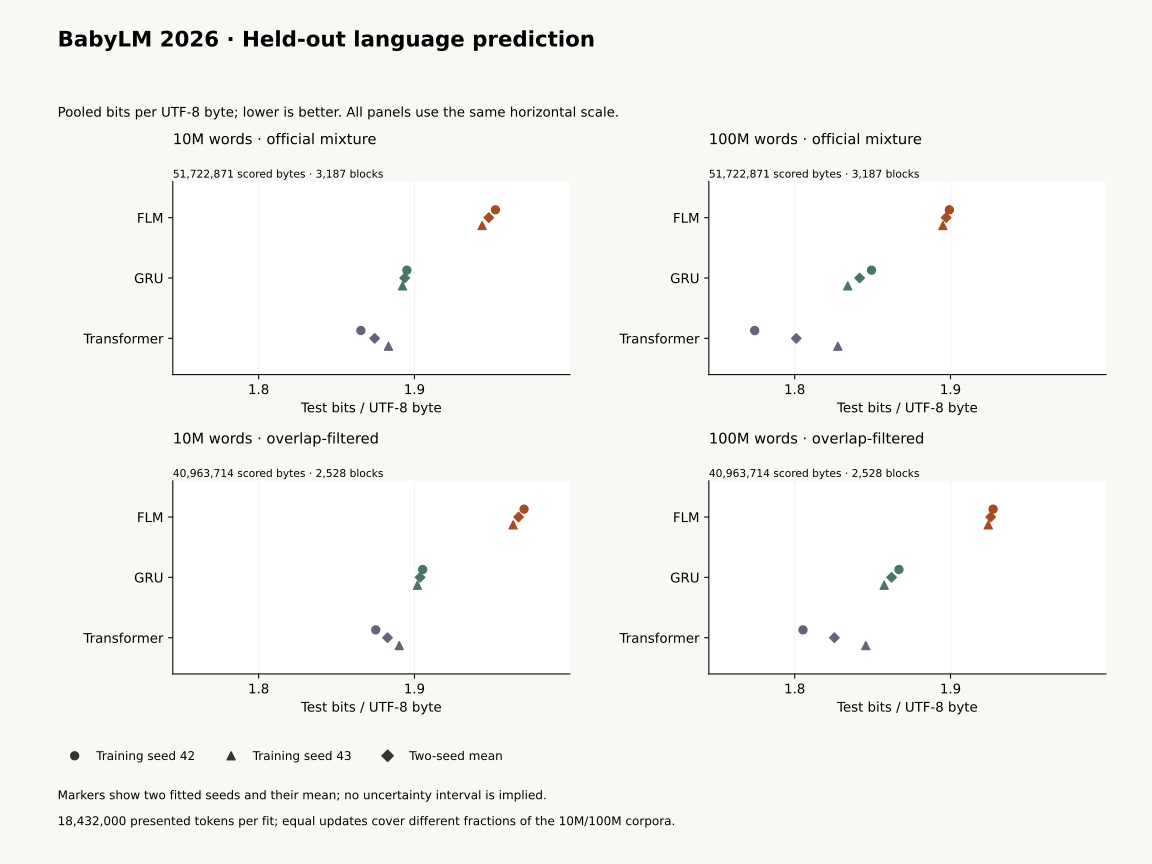
FLM trails both baselines on pooled test loss at both corpus sizes. Every checkpoint was selected before test inference. Lower bits per UTF-8 byte is better; values below are means of two training seeds.
| Training pool / test subset | FLM | GRU | Transformer |
|---|---|---|---|
| 10M / official | 1.947712 | 1.893743 | 1.874470 |
| 10M / overlap-filtered | 1.966842 | 1.903578 | 1.882700 |
| 100M / official | 1.897191 | 1.841673 | 1.801002 |
| 100M / overlap-filtered | 1.925800 | 1.862178 | 1.825476 |
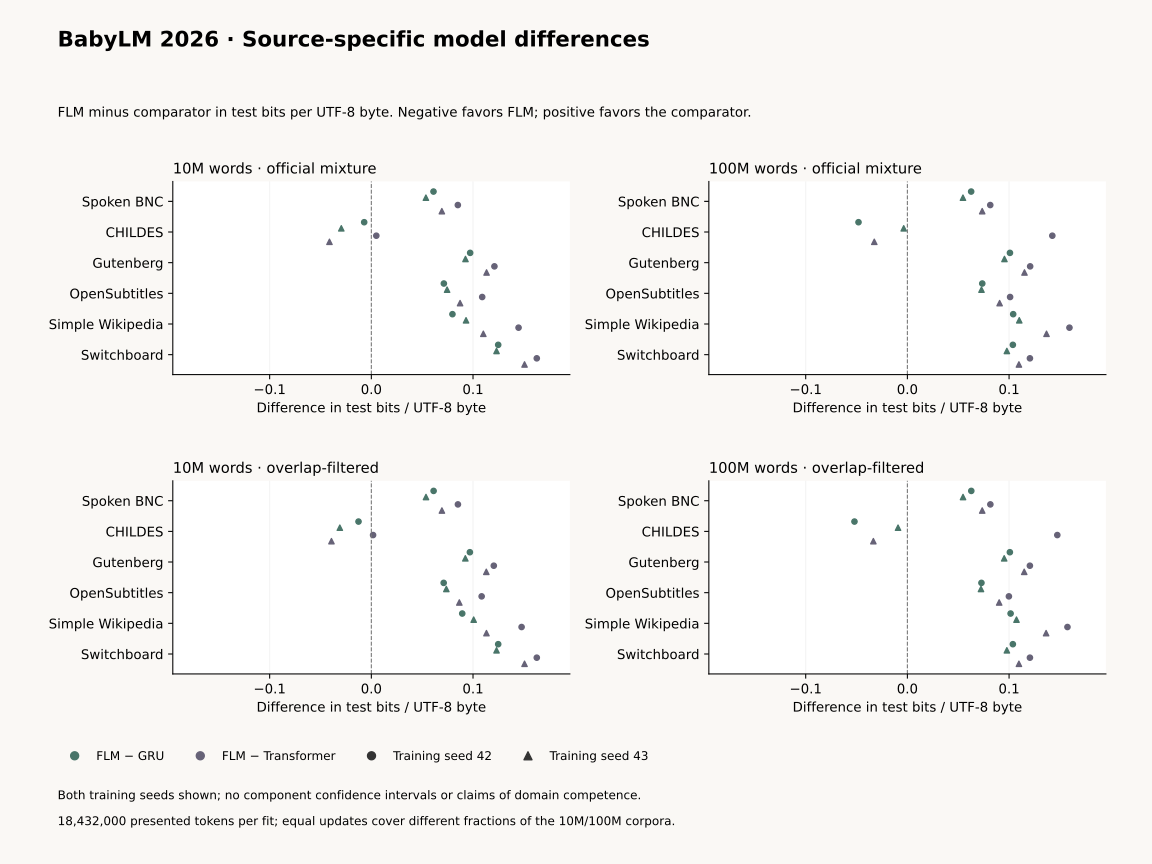
CHILDES is the only source where FLM's two-seed mean beats a baseline: both baselines at 10M, GRU at 100M. The transformer comparison changes sign across seeds. All sixteen pooled paired-block intervals favor the baselines, conditional on these checkpoints; unknown document dependence and only two seeds limit inference.
BabyLM training comparison
The curves below retain the validation history used for checkpoint selection. Validation and held-out test measurements answer different questions.
Loading the published training snapshot…
| Model | Parameters | Bits / byte | Perplexity |
|---|
All 288 unedited continuations are recorded. Every sample reached the 256-token cap; one invalid UTF-8 output remains flagged. FLM has more repetition in aggregate token measures. These models have not demonstrated reliable chatbot ability. Try the earlier BabyLM 10M browser checkpoint. ChatFLM now defaults to the strongest released FLM on the shared BabyLM validation panel, with every primary checkpoint available in its selector.
The next registered selection study has started: 128 fits comparing two Kenyon-cell groups with ranked, random and rewired controls. It has no held-out result yet. Its shorter 3,000-update budget tests selection within that study; it is not an equal-budget replacement for this comparison. A protocol wording correction records that both studies include boundary targets during training.
Split integrity and comparison limits
Whole-line overlap checks found some shared passages between training and evaluation. The official split remains the primary benchmark. A second evaluation excludes blocks containing substantial lines found in either training set, using the same exclusion for all models. Fixed 16 KiB blocks preserve original bytes and source order, but their boundaries do not establish separate books, speakers or conversations.
The results do not establish an anatomical advantage: these twelve fits use the original ranked graph without BabyLM rewiring controls. The completed WikiText topology experiment remains separate.
Grammatical preferences beyond average loss
A fixed BLiMP panel asks whether the model assigns a higher probability to an acceptable sentence than to a minimally changed, unacceptable version. It contains 100 pairs from each of 67 expert-written grammar templates: 6,700 pairs in total. These are evaluation-only examples, selected before reading model scores.
| Model | Seed 42 | Seed 43 | Mean |
|---|
FLM and transformer both average about 54% on this panel, with their ordering changing between training seeds. This does not establish a reliable FLM grammar advantage. These are subset results, so they should not be compared directly with published full-benchmark scores.
Category scores and protocol · Every pair score and checkpoint identity · ZIP
Inference cost on this implementation
| Model | Prefill tokens/s | Next tokens/s | State bytes |
|---|
Compare learning at the same exposure
FLM, GRU and transformer use the same training text, vocabulary and sampled windows. Select the same update count to compare prediction loss. These curves use validation prefixes; the complete held-out test comparison is reported separately above.
Loading measured results…
| Model | Parameters | Bits / byte | Token perplexity |
|---|
The same prompt, three models
Loading fixed-prompt samples…
Download samples and checkpoint hashes
What the evidence can establish
A lower held-out loss measures next-token prediction on the evaluated text. It does not establish reasoning, factual knowledge, consciousness, animal behavior or general conversational ability. The interesting claim to test is whether wiring and multiple timescales improve data efficiency under equal training budgets.
What changes in the “fly”?
Offline training changes the artificial network’s input responses, edge magnitudes, time constants and prediction readout. Those changes can be measured using the same input before and after training. The anatomy provides a location for visualizing the state; it does not make learned text an animal’s experience. Browser learning changes only a separate readout adapter. The body animation is an explicitly designed mapping from state to pose.
Research foundations
- MaleCNS, Janelia — source connectome and anatomical identities.
- Google Research: mapping the complete male fruit-fly brain — reconstruction context.
- Shiu et al., 2024 — a whole-brain computational model of fly behavior.
- Lappalainen et al., 2024 — connectome-constrained models of neural computation.
- Morra et al., 2023 — connectome-inspired reservoir computing.
- Bellec et al., 2020 — recurrent learning with eligibility traces; the separate cue-learning study explores a rate-network approximation.
- SpikeGPT, RWKV and Mamba — prior non-attention and recurrent language-model directions.
- NeuroMechFly v2 — the embodied simulation platform underlying the separate body geometry.
Read the working papers
The main report includes the complete language wiring, slow-state and retrained computation comparisons, subset audit, equations and matched WikiText baselines. The main report also includes the completed 12-fit BabyLM comparison; the data note documents acquisition, overlap analysis and evaluation recovery. Separate learning, sensory wiring and pose-feedback notes report the earlier non-language studies. The 128-fit circuit-selection study is active; its validation and held-out result are pending. Alternative learning rules, language-to-control transfer and learned gait are deferred proposals.
Reproduce and inspect
Loading checkpoint details…
Try all three models on your own prompts
The 14.3 MB inference bundle contains all six published WikiText checkpoints: FLM, GRU and transformer with both training seeds, plus their tokenizer and Python runtime. Run them locally on a CPU with the same prompt and sampling settings. Every exported tensor and fixed buffer matches its selected checkpoint, and all 24 published continuations reproduce in the tested environment.
These are small text continuation models. The bundle runs independently of the repository checkout; ChatFLM also runs all 18 completed primary FLM, GRU and transformer checkpoints in the browser. The README inside the archive includes installation and generation commands.
FLM is an independent research prototype by Kuber Mehta. Original code: MIT. Brain data and AMI transcripts: CC BY 4.0. Body assets retain their upstream licenses.